

The Verdalina Journal - Seasonal Intelligence
The Hour Changes Everything
October Light: How the Season Reads a Ranunculus Palette
October changes the light before it changes the flower. Build a ranunculus palette around the hour your client is actually working in - not the page of the catalogue.
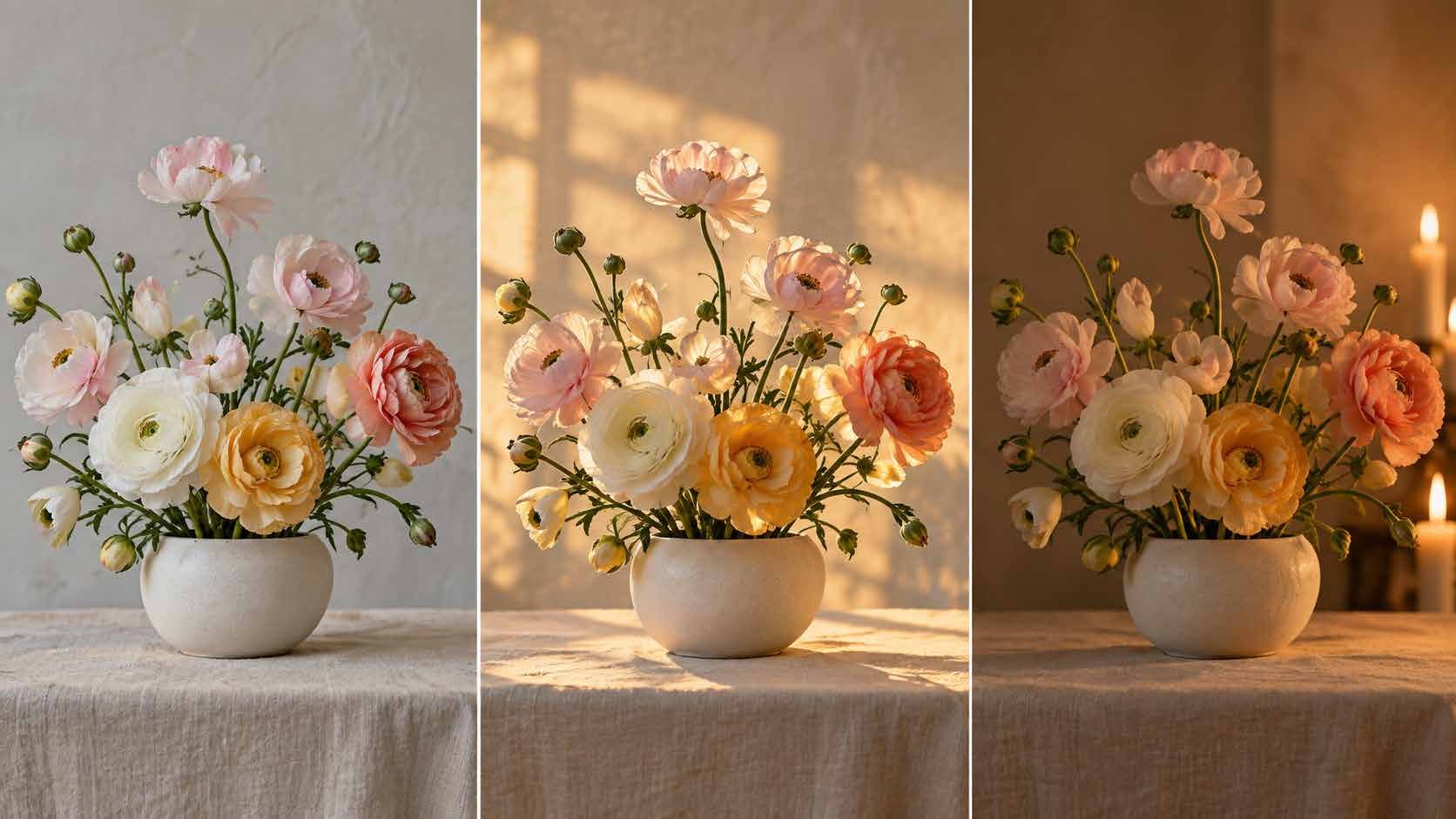
MiddayOpen Sky
Golden HourLow Sun
CandlelightTungsten + Flame
A palette is approved at eleven in the morning, on a screen, in a bright office. It is installed at six in the evening, in a room lit by candles and one tungsten downlight. Those are not the same palette. Nothing about the flowers changed. The light did - and light is the only thing a color is ever made of.
October is the month when that gap opens widest. At the latitudes where most of this work happens - from New York and Chicago to Madrid, London and Amsterdam - the month loses more than an hour of daylight between its first week and its last, and events move indoors and later as it goes. This is a guide to designing for the hour: what October actually changes, how a palette reads at three different times of day, and what to ask a farm so the stems that arrive still work when the doors open.
01 / The October Variable
What October Actually Changes
It is tempting to read October as a change of flower. It is not. The catalogue in October is largely the catalogue of September; what has moved is the sun. It sits lower, it travels a shorter arc, and it turns warm earlier in the afternoon. The variable that changed is the light, not the list.
Three consequences follow, and all three land on the buyer rather than the grower. Ceremonies that ran in daylight a month ago now finish at dusk. Receptions that needed no candles now need them by five. And the same stem, ordered from the same page, is being asked to perform in conditions the September version of that order never met.
Why This Has to Be Settled in the Brief
Light is the one design variable that cannot be corrected on site. A palette that washes out under an open midday sky cannot be darkened with ribbon, and a red that reads black by candlelight cannot be lifted by adding more of it. The correction must happen at the order - which means it has to happen in the brief.
The Pale Brief and the Moody Brief, Two Weeks Apart
Inside the same October, two clients will describe two opposite months. The first, planning the opening weekend, is still living in late summer: bright rooms, long afternoons, a palette that wants air. The second, planning the closing weekend, has already arrived somewhere else: early dusk, candles on the table, a palette that wants depth.
Neither is wrong, and neither is really a matter of taste. They are two different lighting conditions, three weeks apart, described in the language of color. Read them that way and the brief stops being an argument about what is seasonal and becomes a technical question with an answer.
For a wholesale buyer that is the useful reframe of the month. October is not one palette with one peak. It is two lighting seasons inside four weeks, and an order built to cover both will sell through both.
02 / Read the Hour
Reading a Palette by Time of Day
Three lighting conditions are carried through almost every October event. Each one does something specific and predictable to a palette, and each one can be designed for.
Midday, Open Sky
The most intense and neutral light, and the least forgiving to pale work. Whites and creams can merge; deep tones flatten. Contrast must be built into the palette.
Late Afternoon
Low-angle warmth turns cream to gold, strengthens coral and yellow, and rewards translucency because light travels through the petal.
Candle + Tungsten
Warm, low-intensity light turns white to cream, makes pale pink read off-white, and collapses red and purple. Form and value survive.
That last line has a commercial edge worth naming. In a candlelit room the distinction a client is paying for may simply not be visible: two stems that read as a considered pairing at the tasting can read as one stem repeated by eight o'clock.
03 / Petal Behavior
Where Each Ranunculus Family Comes In
The useful way to place the families is not by color and not by ranking. It is by what their petals do with light, because that is the thing changing from hour to hour. On that measure, ranunculus splits cleanly in two.
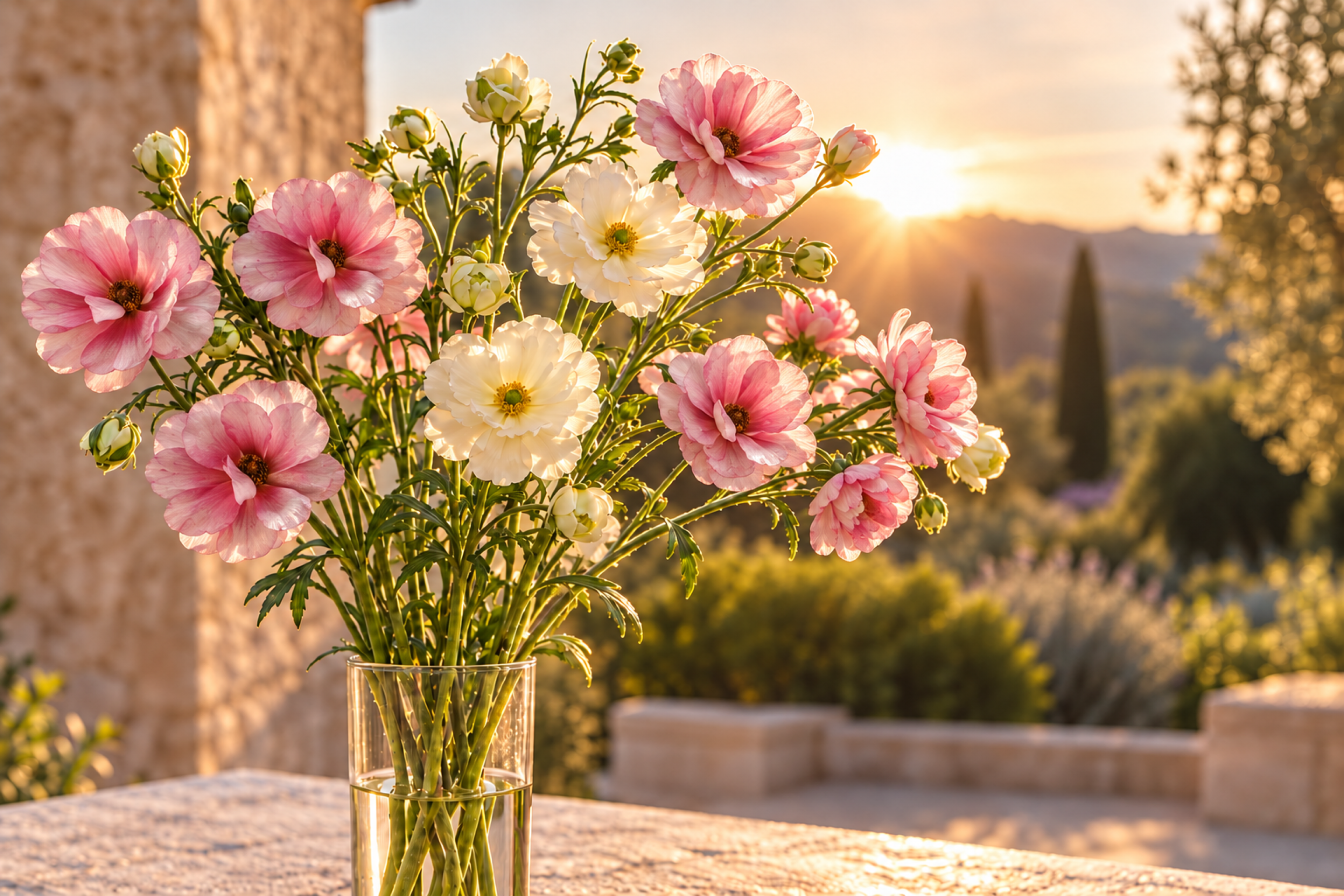
Petals that let light through
The Butterfly line is the clear case: fine, single-layered petals carried on airy stems. Backlit or side-lit late in the afternoon, that translucency is the entire effect. Under flat midday sun or by candle, the same stem loses precisely the quality it was chosen for.
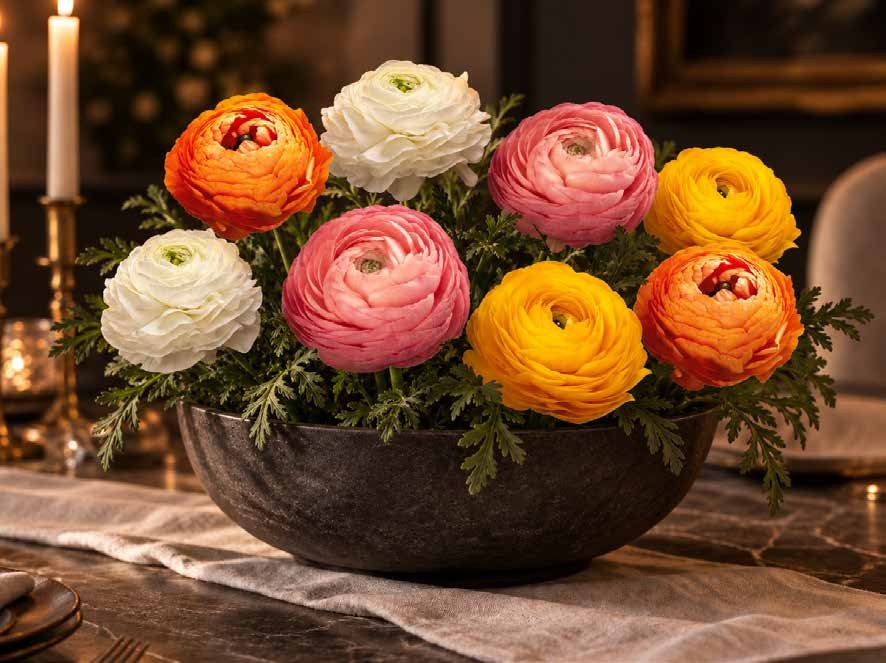
Petals that bounce light back
The densely layered heads - Elegance, Cloni Success and Cloni Pon Pon - behave the opposite way. They hold shape and value under hard, flat or very low light, because they read as form rather than as a lit surface.
That is the whole assignment, and it runs in both directions: a family is not better or worse, it is earlier or later in the day. A designer building a five-o'clock ceremony that moves to a candlelit dinner is building two palettes for one event - and can draw both from the same catalogue without repeating a stem.
It is also why an order that names only colors is under-specified. Two stems can share a color word and behave like different flowers at the hour that matters.

04 / Three Palettes
Build the Palette Backward From the Hour
Each direction starts from the hour and works back to the stem, which is the reverse of how palettes usually get built. Varieties are named only where the catalogue supports it; the same roles can be found in any family once the behavior is right.
- The noon garden party: Build the contrast, because the light will not. Use a cream anchor such as Butterfly Graces or Keramos, a warm mid-tone such as Minoan, and a genuine dark. Avoid a palette made only of pales: under open sky they merge.
- The five-o'clock ceremony: Spend on translucency. Place the airiest stems where light comes through them - at the back and edges of the arrangement. A tone-on-tone pink group such as Butterfly Hera, Isis and Melissa finds depth here that it never shows at noon.
- The candlelit table: Design in value, not color. Use dense layered heads, a clear step between light and dark, and one accent saturated enough to survive the warm cast. Butterfly Eris in coral is the kind of stem that still announces itself.
05 / The Order
What to Ask the Farm in October
A better October order is not a longer one. It is one that carries four pieces of information a grower can actually act on.
- The hour, not only the date: A Saturday in October is two different jobs at two in the afternoon and at seven in the evening.
- How the room is lit: Daylight, tungsten, or candles. That single line changes which behavior is wanted and often changes the variety.
- A pale anchor and a dark accent: Ordering only the middle of a palette is what produces flat installations. The ends are what make the middle read.
- One substitute per role: Not a substitute of the same color - a substitute that does the same thing with light. That is the swap that survives a short week.
An order written that way is easier to fill and easier to defend. It tells the farm what the flowers have to do, not only what they have to look like - and in a month that loses an hour of daylight between its first week and its last, that is the difference between a palette that was approved and a palette that worked.
The Closing Thought
October does not ask a designer to change flowers. It asks them to notice that the light has already changed, and to order accordingly. The catalogue is the same catalogue. The month is what decides how it reads.
See the light. Feel the hour. Follow the palette.
Write to us with the hour and the light of your October dates, and we will tell you which stems are cutting. Request the full variety catalogue for your next event or wholesale program.
Request the Variety Catalogue